
How Traffic Warrants Work in St. Joseph County
Every traffic civil infraction and minor traffic misdemeanor in St. Joseph County runs through the 3B District Court traffic division. The division offers preset fines and an informal hearing, and it posts its own payment instructions and clearance timing. A ticket turns into a warrant problem only when the driver ignores the citation, misses a date, or fails to follow the court's judgment. One warning on the traffic page deserves attention: a suspended-license clearance does not happen right away. Court steps and state steps run on separate clocks. The court sits in the Courts' Building at 125 W. Main St. in Centreville, on the main floor.
The 3B Traffic Division Is Where a Ticket Lives
A ticket in St. Joseph County does not belong to the sheriff, the Secretary of State, or a city hall counter. It belongs to the district court that received the citation. That is why paying at the wrong window leaves the case open.
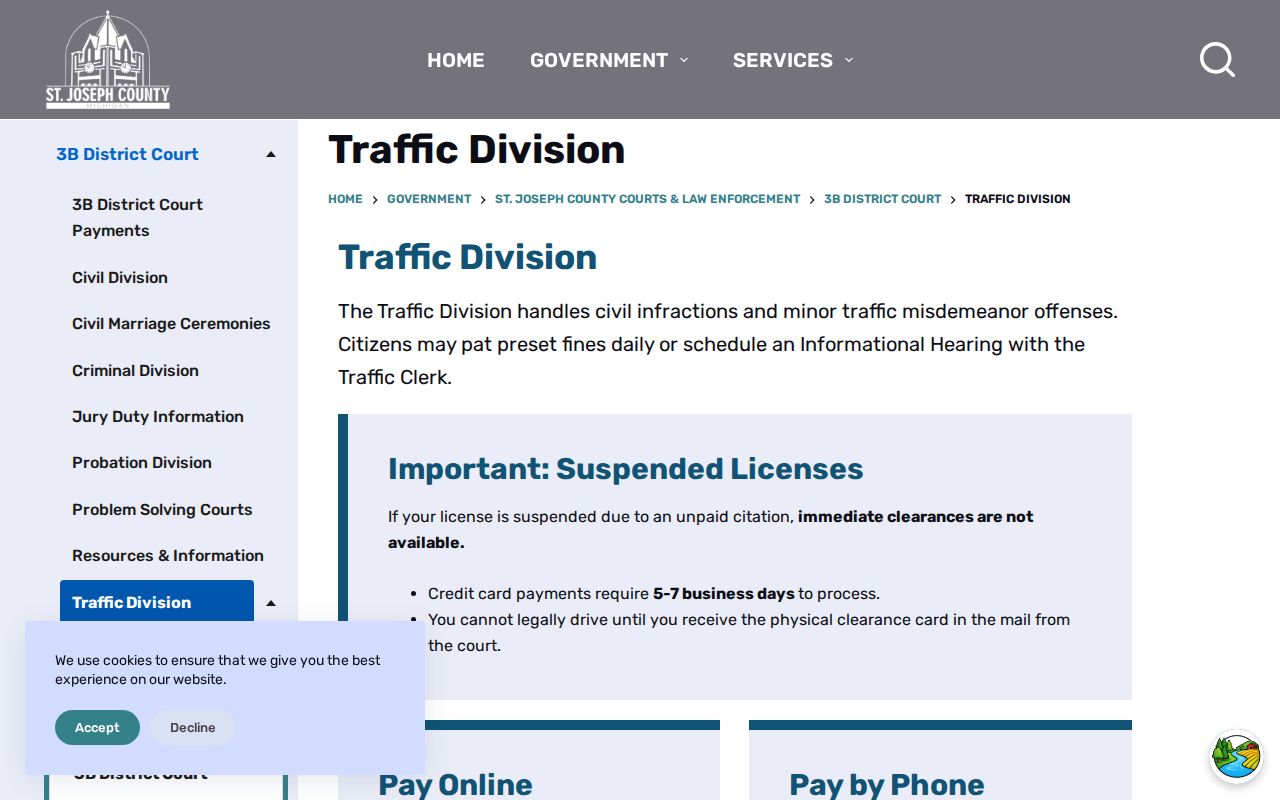
The county's traffic division page lays out the hearing option, the preset fine option, and what follows a payment. The fine schedule lists the traffic office at (269) 467-5503. The court's general line is (269) 467-5627.
Note: The county's traffic fine schedule is dated 2018 and states that amounts can change, so treat its figures as historical rather than current.
St. Joseph County Traffic Warrant Checks
A traffic warrant check is really a case check in St. Joseph County. The case number is the fastest way in, so work the channels below and do not stop at the first blank screen.
- Read the citation for the citation number, the date, and the court named on the ticket.
- Search eligible case information in MiCOURT Case Search by name, or by case year and number.
- Call the 3B traffic division at (269) 467-5503 and ask what the docket shows for that citation.
- Ask whether the file needs a payment, a hearing, a motion, or an appearance, and what the court requires first.
- Request a specific file or docket entry with the copy and file review request if you need it in writing.
The local court access order asks for a case number or party names. It will not dig up broad traffic history without a specific St. Joseph County case.
Paying Through FivePointPayments and PLC 1589
St. Joseph County publishes one payment system plus a phone option tied to a specific location code. Both cover only the payments the court identifies, not every obligation in a case.
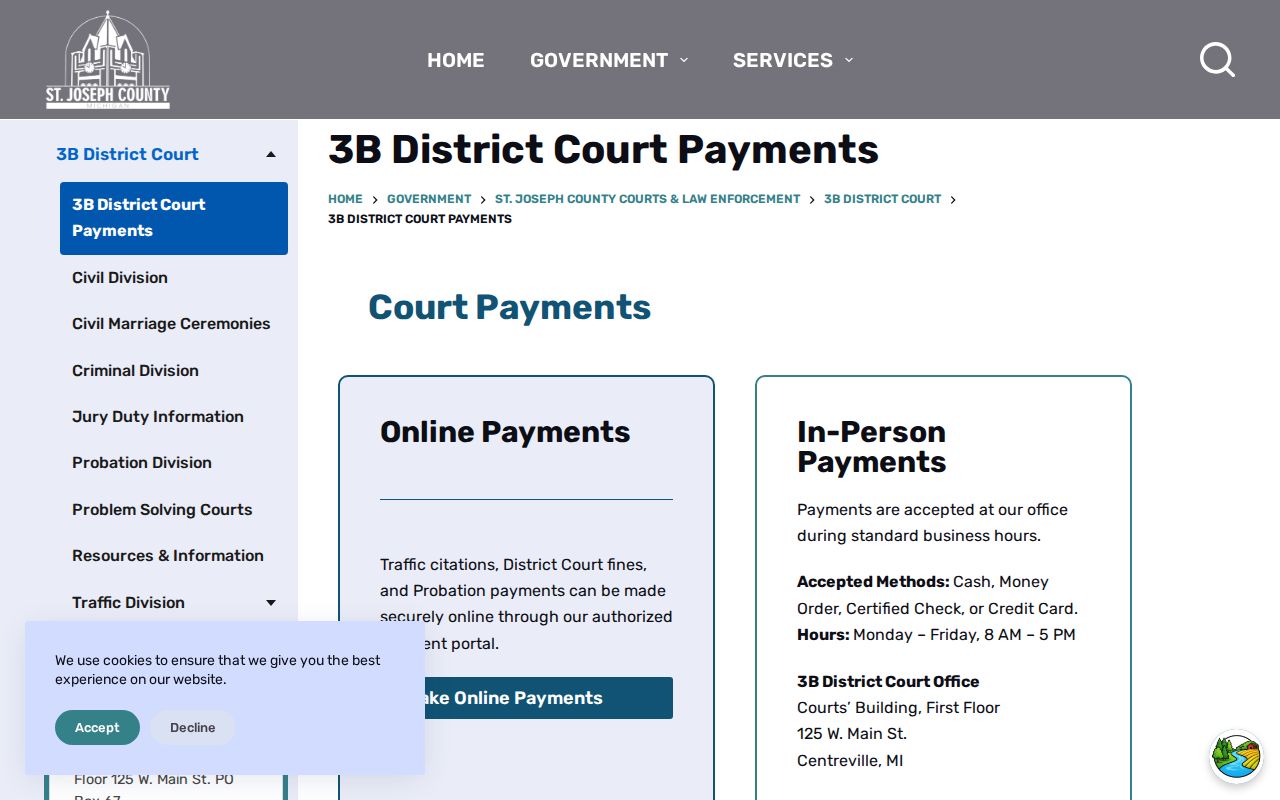
- In person at the first-floor court counter, Monday through Friday, 8:00 a.m. to 5:00 p.m.
- By cash, money order, certified check, or credit card at the counter.
- Online through the provider the county links from its online payments page, which notes a 3.5 percent service fee.
- By automated phone at (888) 604-7888 using Pay Location Code 1589.
St. Joseph County routes online traffic warrant payments through its court payments page, which lists each option.
Traffic Warrants: What They Show
A traffic file mixes the citation, the court's judgment, payment entries, and any default or failure-to-appear event. Read the entries in order. The last one tells you where a St. Joseph County case stands.
| Citation or case number | The exact match for the file, for example TR-24-1234 as a fictional sample |
|---|---|
| Violation and date | The citation or misdemeanor charge and the date of the event |
| Court setting | A notice of appearance, an informal hearing, or a later date |
| Default or failure to appear | The court's record of a missed answer or appearance |
| Fine, cost, or bond | The ordered obligation, if the court recorded one |
| Payment entry | A receipt or compliance event, which is not the same as a recalled warrant |
| Warrant status | Active, recalled, served, or another entry the court reads |
The file will not show a driving history or an insurance score. Those are not court records, and a St. Joseph County traffic case is what matters here.
Five to Seven Business Days After Card Payment
Timing is where this court is unusually specific, and anyone planning to drive should listen closely. When a license was suspended over an unpaid citation, immediate clearance is not available. A card payment can take five to seven business days to process. Then the person must wait for the physical clearance card that the court mails before driving legally. That gap breeds a common misunderstanding. The payment only starts the process. The court's records and the state's record each update on their own schedule, and a bank confirmation is neither a clearance card nor a warrant recall. Ask the St. Joseph County traffic clerk when the case will show as satisfied and when the clearance document goes out.
Clearing a St. Joseph County Traffic Warrant
Clearing a warrant usually means resolving the citation behind it. The court decides which route fits the file. The steps below keep a St. Joseph County case moving in order.
- Confirm the open entry and the exact amount with the traffic division before paying anything.
- Pay the fine through an accepted channel, or ask for an informal hearing if the citation is contested.
- Appear on the date the court sets, or file the motion the court identifies for a default.
- Ask the clerk to confirm that the warrant entry is recalled and the case is closed.
- Wait for the court's clearance document before driving if a license suspension was involved.
Warning: An unpaid citation does not fix itself, and a court payment made to the wrong office leaves the file open and the warrant in place.
Why the 2018 Fine Schedule Is Not Current Pricing
The county still hosts a traffic fines schedule dated January 26, 2018. It lists the traffic office, business hours, payment instructions, a pay location code, and selected preset fines, and it warns that amounts can change without notice. That date is the reason to call instead of calculate. Someone who pays a 2018 amount may still owe a balance, and a balance can keep a case open even after a partial payment. Treat the document as a directory, not a price sheet. Its office, hours, and payment route remain useful, but every dollar figure needs current confirmation from the St. Joseph County court.
How Traffic Warrants Trigger License Holds
One St. Joseph County traffic case can carry two separate consequences, and different offices clear them. The court controls the case itself. The state administers the license record once the court sends notice.
| Mechanism | What Triggers It | What It Does |
|---|---|---|
| Traffic bench warrant | An unanswered citation or a missed court date | Authorizes arrest on the court case |
| Failure to appear | A missed scheduled court setting | Adds a docket event that can lead to a bench warrant |
| License clearance hold | An unpaid judgment reported through the court process | Blocks clearance until the court issues the release document |
The state provisions governing this are MCL 257.321a and MCR 6.615(B). They describe notice and a Secretary of State step, not an automatic result for every case.
Setting Aside a Civil-Infraction Default
St. Joseph County drivers who missed a civil-infraction hearing have a formal fix. The 3B forms folder holds a statewide form for this exact problem. It is the CIA 04 motion to set aside default. The form asks for the case number and judge, the judicial district, and the court address. It also wants the complainant, the defendant, and the infraction's date and location. You must list the statute or ordinance, state whether the motion is within 14 days, give a good-cause explanation, describe the defense, and post a cash bond equal to the fine and costs. A hearing section, an order section, and a proof of service round it out. Remember, this is a remedy for one kind of default, not a warrant lookup. Confirm with the court that the form fits the case before filing it.